
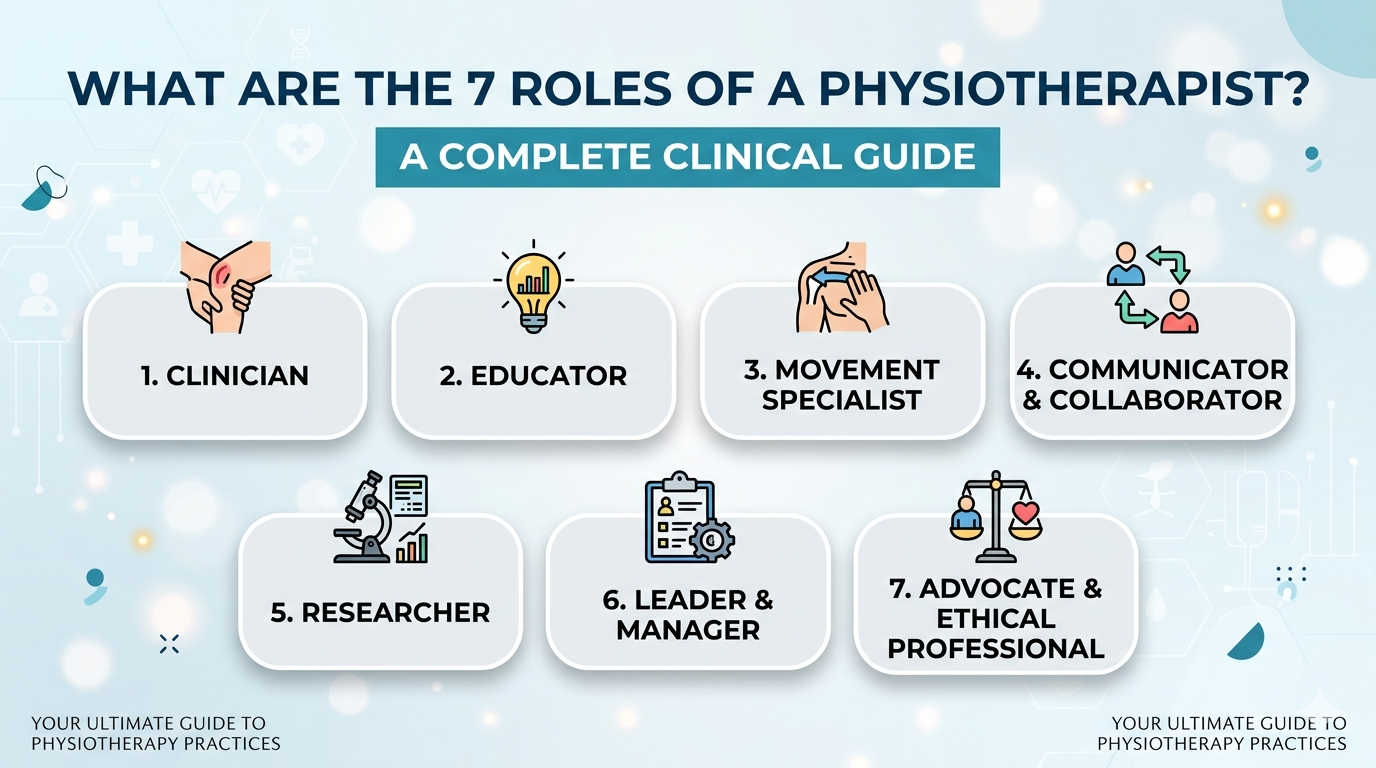
What Are the 7 Roles of a Physiotherapist? A Complete Clinical Guide
Most people think physiotherapy is only for athletes who pull a hamstring or elderly patients recovering from a hip replacement.
The reality is far more expansive — and far more important.
Physiotherapy is one of the most versatile clinical professions in modern healthcare. A skilled physiotherapist in Mumbai doesn’t just treat pain. They assess, rehabilitate, educate, prevent, and empower. They work with children and with 80-year-olds. They treat professional athletes and office workers. They show up after surgery, after strokes, after accidents, and often — long before any of those happen.
So what exactly does a physiotherapist do? What are the 7 core roles that define the profession?
This guide gives you the complete clinical picture — written from the perspective of a practitioner who lives these roles every day.
Why Understanding a Physiotherapist’s Role Matters
Before we break down the seven roles, it’s worth understanding why this question matters in the first place.
In India — and in Mumbai specifically — there is still a significant gap between what physiotherapy can do and what patients believe it can do. Many people delay treatment, assume they need surgery, or keep taking painkillers instead of addressing the root cause of their dysfunction.
That gap exists because physiotherapy’s role is misunderstood.
When you understand what a physiotherapist actually does, you become better at recognizing when to seek help, what to expect from treatment, and how physiotherapy fits into your overall healthcare journey.
The 7 Core Roles of a Physiotherapist
Role 1: Injury Rehabilitation Specialist
This is the role most people associate with physiotherapy — and for good reason. Rehabilitation after injury is the cornerstone of the profession.
When you injure a muscle, tear a ligament, fracture a bone, or damage a joint, the body initiates a healing response. But healing and full functional recovery are not the same thing. Without guided rehabilitation, scar tissue forms poorly, strength doesn’t return evenly, movement patterns compensate incorrectly, and re-injury risk increases dramatically.
A physiotherapist’s role is to guide the tissue through every phase of healing:
- Acute phase: Managing swelling, protecting the injury, maintaining surrounding mobility
- Sub-acute phase: Introducing controlled loading, rebuilding range of motion, beginning strength work
- Rehabilitation phase: Progressive strengthening, sport- or task-specific training, movement re-education
- Return to function: Confirming full capacity before resuming activity
For athletes, this process is even more structured. Sports physiotherapy applies sport-specific biomechanics testing, load management protocols, and performance benchmarks to ensure safe return to competition — not just absence of pain.
Dr. Niraj Parmar has worked directly with Pro Kabaddi League teams including Tamil Thalaivas and U Mumba, managing elite-level sports injuries in real competitive environments. That experience translates into clinical precision for every rehabilitation case — from professional athletes to active individuals.
Common conditions treated:
- Ligament sprains (ACL, MCL, ankle)
- Muscle tears (hamstring, quadriceps, calf)
- Rotator cuff injuries
- Tennis elbow, golfer’s elbow
- Stress fractures and bone stress injuries
Role 2: Pain Management Clinician
Chronic pain is one of the most debilitating and undertreated conditions globally. In India, millions of people live with persistent back pain, neck pain, joint pain, and musculoskeletal conditions — often relying on medications that mask symptoms rather than resolve causes.
A physiotherapist’s role in pain management is fundamentally different from medication: it targets the source of pain, not just the sensation.
Through clinical assessment, a physiotherapist identifies whether pain is coming from a joint, a muscle, a nerve, a postural pattern, or a movement dysfunction. Then they address it directly.
The pain management toolkit available to a physiotherapist includes:
Manual therapy — Hands-on joint mobilization, manipulation, and soft tissue work that directly reduces pain, restores movement, and normalizes neuromuscular function. Manual therapy has strong evidence for cervical pain, lumbar spine conditions, shoulder pathology, and peripheral joint dysfunction.
Dry needling physiotherapy — Fine needles are inserted into myofascial trigger points — tight, hyperirritable knots within muscle tissue that refer pain to other areas. Dry needling releases these points, reducing local and referred pain, restoring muscle length, and improving tissue circulation. It is particularly effective for chronic muscle pain, tension-type headaches, and upper trapezius syndrome.
Taping physiotherapy — Kinesio taping and rigid taping techniques offload painful structures, reduce swelling, improve proprioceptive feedback, and facilitate correct muscle activation. Unlike a simple brace, therapeutic taping is applied with specific tension, direction, and purpose — a clinical decision, not a generic support.
Therapeutic exercise — Targeted strengthening and mobility work corrects the underlying movement impairments driving the pain cycle.
Electrotherapy modalities — TENS, ultrasound, and laser therapy provide additional pain relief and support tissue healing.
The goal isn’t to manage pain forever. It’s to resolve it.
Role 3: Post-Surgical Rehabilitation Expert
Surgery fixes structure. Physiotherapy restores function.
This distinction is critical. A surgeon can reconstruct an ACL ligament, replace a knee joint, or decompress a spinal nerve — but none of that automatically translates into a patient being able to walk, climb stairs, return to sport, or live without discomfort. That’s where post surgical rehabilitation begins.
Post-surgical physiotherapy is one of the most evidence-based and outcome-critical applications of the profession. The research consistently shows that quality rehabilitation determines the final result of surgery — in many cases more than the surgical technique itself.
What post-surgical physiotherapy involves:
- Day 1–2 post-op: Breathing exercises, circulation work, basic joint protection, swelling control
- Week 1–4: Progressive range of motion, gentle muscle activation, scar tissue management, gait re-education
- Month 1–3: Strength rebuilding, neuromuscular control, proprioception training
- Month 3–6+: Sport- or function-specific loading, return-to-activity testing, long-term maintenance
Specific post-surgical protocols exist for every procedure — knee replacement, hip replacement, rotator cuff repair, spinal decompression, ACL reconstruction, Achilles tendon repair, and more. A physiotherapist who specializes in post-surgical care doesn’t apply a generic program. Every protocol is customized to the procedure performed, the surgeon’s notes, the patient’s baseline, and the functional goals ahead.
Without structured post-surgical physiotherapy:
- Joints stiffen beyond the surgical correction
- Muscles atrophy and don’t return to baseline strength
- Movement compensations develop and cause secondary problems
- Risk of re-injury on return to activity increases significantly
Role 4: Movement and Biomechanics Analyst
One of the most underappreciated roles of a physiotherapist is their function as a movement analyst.
Pain, injury, and dysfunction rarely occur in isolation. Almost always, they are the result of a movement pattern that has gone wrong — a compensation, an imbalance, a poor loading strategy, or a habituated posture that places abnormal stress on one structure over time.
A physiotherapist trained in biomechanics assessment can identify exactly where the breakdown is occurring:
- Why your knee hurts despite no acute injury (likely hip abductor weakness, foot pronation, or tibial rotation during gait)
- Why your lower back pain keeps coming back after treatment (likely lumbar extension compensation for poor thoracic mobility)
- Why your shoulder impinges on overhead movement (likely scapular dyskinesis and altered rotator cuff activation timing)
This analytical role is what separates a physiotherapist from a massage therapist or a gym trainer. The ability to watch you walk, squat, reach, or lift and identify the precise movement impairment causing your problem — that is clinical expertise.
Orthopedic physiotherapy in particular relies heavily on this biomechanical lens. Conditions like osteoarthritis, chronic tendinopathy, and recurring muscle injuries almost always have an identifiable movement cause — and a movement-based solution.
Role 5: Neurological Rehabilitation Facilitator
When the nervous system is damaged — through stroke, spinal cord injury, traumatic brain injury, or progressive conditions like Parkinson’s disease and multiple sclerosis — the body loses its ability to communicate between brain and muscle efficiently.
Neurological physiotherapy’s role is to facilitate neuroplasticity — the brain’s ability to rewire and rebuild new neural pathways to compensate for damaged ones.
This is complex, specialized, and profoundly meaningful work.
What neurological physiotherapy addresses:
- Stroke rehabilitation — relearning walking, arm function, balance, coordination
- Parkinson’s disease — gait training, fall prevention, posture, rigidity management
- Spinal cord injury — maximizing residual function, wheelchair skills, transfers
- Traumatic brain injury — cognitive-motor retraining, balance rehabilitation
- Multiple sclerosis — fatigue management, fall prevention, mobility maintenance
The techniques used include task-specific training (repetition of meaningful functional movements), gait re-education, constraint-induced movement therapy, balance and vestibular rehabilitation, and neurodynamic mobilization.
Neurological physiotherapy requires patience, precision, and a deep understanding of how the nervous system responds to injury and rehabilitation. The outcomes can be extraordinary — patients who were told they’d never walk again regaining the ability to do so through dedicated, expert neuro rehab.
Role 6: Preventive Health and Wellness Educator
The best physiotherapy outcome is the injury that never happens.
Prevention is a core, though often overlooked, role of the physiotherapist. In sport, workplace health, and aging populations, proactive physiotherapy intervention reduces injury rates, sick days, chronic pain development, and long-term disability.
In sports: Structured pre-season injury screening, movement assessment, and corrective programs identify athletes at high injury risk before they get hurt. Evidence-based injury prevention programs for ACL tears, hamstring injuries, and shoulder problems have been shown to reduce incidence by 30–50%.
In the workplace: Ergonomic assessment and musculoskeletal screening reduce occupational injury — particularly for desk workers, manual laborers, and healthcare professionals whose physical demands place repetitive stress on specific structures.
In aging: Falls are the leading cause of injury-related death in adults over 65. Physiotherapy-led balance and strength training programs significantly reduce fall risk and maintain functional independence for longer.
As a wellness educator: Physiotherapists explain why pain is happening, teach patients how to move safely, provide home exercise programs, and give patients the knowledge to manage their own health between sessions. This educational role is empowering — it shifts the patient from passive recipient to active participant in their own recovery.
Role 7: Sports Performance Optimizer
The final role extends physiotherapy beyond rehabilitation into elite performance enhancement.
Sports physiotherapy at the performance level goes beyond treating injuries after they happen. It involves understanding the physical demands of a specific sport, identifying a player’s physical limitations relative to those demands, and designing targeted programs to close the gap.
This is the work Dr. Niraj Parmar does with Pro Kabaddi League athletes — where the difference between a player who gets injured in competition and one who doesn’t often comes down to tissue quality, movement efficiency, and load management in the weeks prior.
Performance physiotherapy includes:
- Movement screening and functional assessment
- Strength and power profiling
- Soft tissue quality assessment and maintenance
- Load monitoring during training cycles
- Sport-specific mobility and stability programming
- Pre-competition preparation protocols
- In-competition sideline assessment and management
Taping physiotherapy plays a key role here — athletes use kinesio and rigid taping not just for injury support but for proprioceptive enhancement during high-demand movement, improving joint position sense and movement efficiency under fatigue.
Dry needling physiotherapy is similarly used as a maintenance tool — not waiting for a muscle to become painful, but addressing trigger point development proactively during training blocks to maintain tissue quality and prevent the accumulation that leads to injury.
This preventive-performance approach is what distinguishes elite sports physiotherapy from basic sports injury treatment.
How These 7 Roles Work Together in Practice
In the real world, these roles don’t operate as separate silos. A single patient may experience several of them within one clinical relationship.
Consider this clinical scenario:
A 32-year-old recreational footballer presents with ACL reconstruction 8 weeks post-op. He needs post-surgical rehabilitation (Role 3) to restore knee function. His biomechanical assessment (Role 4) reveals hip abductor weakness and poor landing mechanics that likely contributed to the original injury. His pain assessment (Role 2) identifies trigger points in his quadriceps affecting activation quality — addressed with dry needling (Role 2). Taping physiotherapy (Role 2) is used to support the patella during early loading phases. As he progresses, a sports performance return-to-sport protocol (Role 7) ensures he’s biomechanically ready before his first match back. And throughout, education (Role 6) teaches him the pre-hab routine that will reduce his re-injury risk going forward.
That is physiotherapy done properly. That is the full scope of what the best physiotherapist in Mumbai brings to your care.
What Makes an Expert Physiotherapist Different?
Not all physiotherapy is equal. The difference between a generalist applying a generic protocol and a specialist who precisely assesses, diagnoses, and designs your program is the difference between plateauing and recovering.
Here is what to look for:
Clinical reasoning — Can they explain why they are doing what they are doing? Treatment should be based on a clear diagnosis, not habit.
Specialization depth — Orthopedic physiotherapy requires different knowledge than neurological physiotherapy. Look for a practitioner with genuine depth in the area relevant to your condition.
Evidence-based techniques — Manual therapy, dry needling, therapeutic exercise, and taping all have strong research bases when applied correctly. Be cautious of practitioners who rely heavily on passive modalities with little active rehabilitation component.
Progressive programming — Recovery is not static. Your program should evolve week by week, with clear progression criteria and functional benchmarks.
Communication with your medical team — The best physiotherapists work alongside surgeons, orthopaedic specialists, and general practitioners — not independently. Coordinated care produces better outcomes.
Book an Appointment with Dr. Niraj Parmar — Physiotherapist in Mumbai
If you’re dealing with pain, recovering from surgery, preparing for sport, or simply not moving the way you should — you don’t need to wait for things to get worse.
Dr. Niraj Parmar is one of the most experienced physiotherapists in Mumbai, currently serving as a Senior Sports Consultant at Dr. L.H. Hiranandani Hospital, Powai. With 7+ years of clinical experience, a 99% recovery rate, and direct expertise across all 7 roles of physiotherapy — he brings elite-level thinking to every patient’s care.
Services available at the clinic:
- Sports Physiotherapy
- Orthopedic Physiotherapy
- Manual Therapy
- Dry Needling Physiotherapy
- Taping Physiotherapy
- Post Surgical Rehabilitation
📍 Location: Dr. L.H. Hiranandani Hospital, Powai, Mumbai – 400076 📞 Call / WhatsApp: +91 902 222 1342 📧 Email: nirajp8097@gmail.com 🕐 Clinic Hours: Monday – Friday, 10 AM – 8 PM
Frequently Asked Questions (FAQ)
Q1: What are the 7 roles of a physiotherapist?
The 7 core roles of a physiotherapist are: (1) Injury Rehabilitation, (2) Pain Management, (3) Post-Surgical Rehabilitation, (4) Movement and Biomechanics Analysis, (5) Neurological Rehabilitation, (6) Preventive Health and Wellness Education, and (7) Sports Performance Optimization.
Q2: What does a physiotherapist in Mumbai do differently from a general practitioner?
While a general practitioner diagnoses and manages medical conditions, a physiotherapist specializes in restoring physical function, movement, and strength. They use hands-on techniques, exercise therapy, dry needling, taping, and rehabilitation protocols to address musculoskeletal, neurological, and sports-related conditions.
Q3: When should I see a physiotherapist?
You should see a physiotherapist for any condition involving pain, restricted movement, sports injury, post-surgical recovery, neurological impairment, or if you simply want to improve your physical performance or prevent injury. You do not always need a doctor’s referral to book an appointment.
Q4: What is the difference between sports physiotherapy and orthopedic physiotherapy?
Sports physiotherapy focuses specifically on sports injuries, athletic performance, and return-to-sport rehabilitation. Orthopedic physiotherapy covers a broader range of bone, joint, and muscle conditions — including arthritis, post-fracture recovery, and joint replacement rehabilitation. There is significant overlap, and Dr. Niraj Parmar is expert in both.
Q5: Is manual therapy painful?
Manual therapy, when performed by a trained physiotherapist, should not be painful. Some techniques may cause mild temporary soreness — similar to post-exercise discomfort — but the goal is always to reduce pain and improve movement, not create it.
Q6: How does dry needling physiotherapy work?
Dry needling involves inserting fine needles into myofascial trigger points within muscle tissue. This releases the taut band of muscle, stimulates a local healing response, reduces referred pain, and restores normal muscle length and activation. It is different from acupuncture and is based on Western anatomy and neurophysiology.
Q7: How many physiotherapy sessions will I need?
This depends on the nature and severity of your condition. Simple acute injuries may resolve in 4–8 sessions. Post-surgical rehabilitation programs typically run for 3–6 months. Dr. Niraj Parmar provides a clear treatment plan and timeline after the initial assessment, so you always know what to expect.
Q8: Does Dr. Niraj Parmar treat professional athletes?
Yes. Dr. Niraj Parmar is a Senior Sports Consultant at Dr. L.H. Hiranandani Hospital and has worked with Pro Kabaddi League teams including Tamil Thalaivas and U Mumba. He applies the same elite standards of assessment and rehabilitation to all patients — athletes and non-athletes alike.