
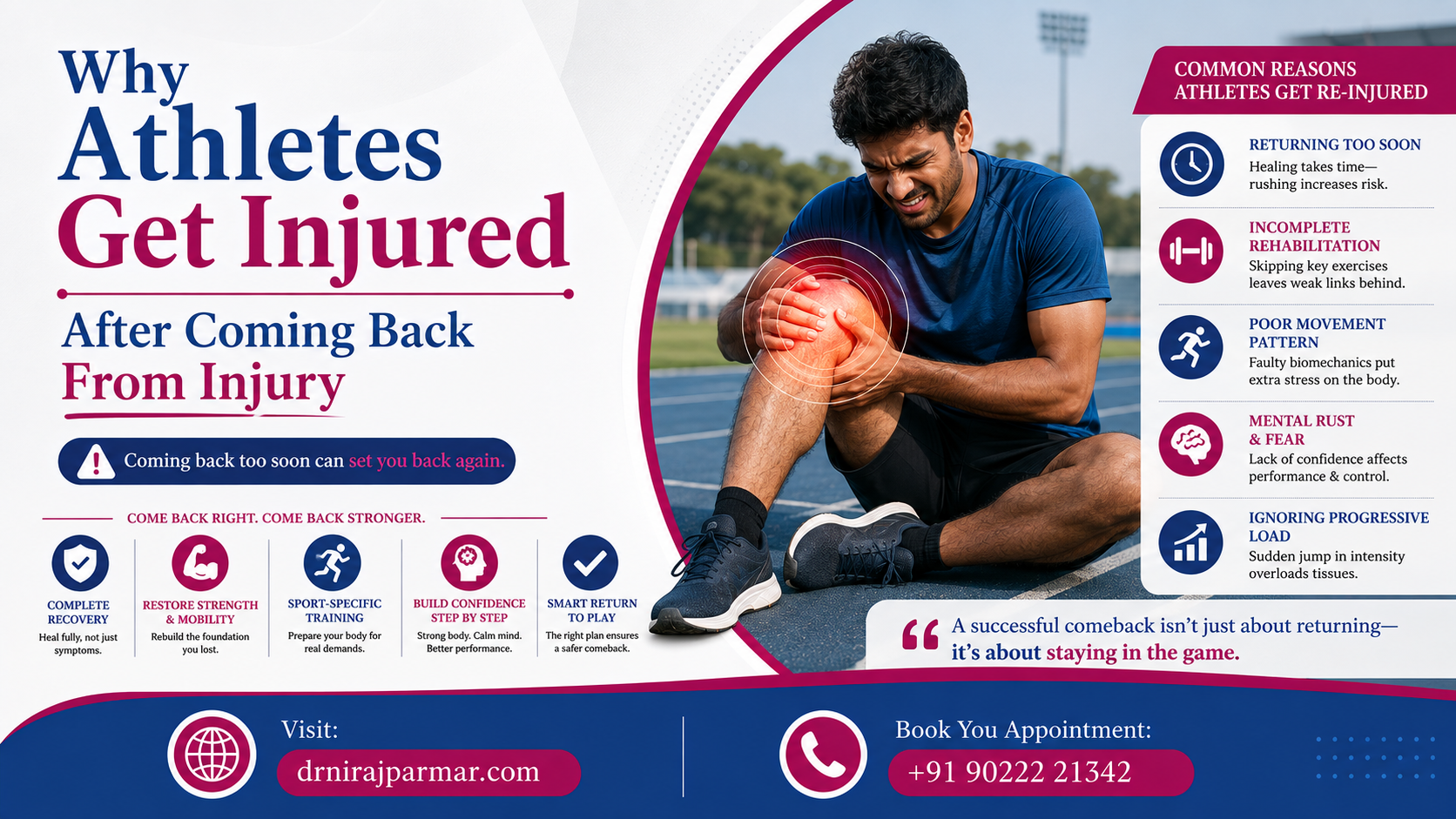
An athlete may be declared “fit” and still not be fully ready for competition.
This is one of the most frustrating realities of sports injury rehabilitation. An athlete completes rehabilitation, feels better, passes basic strength tests and returns to training, only to experience another injury weeks or months later.
So, why does this happen?
1. Healing Is Not the Same as Being Competition-Ready
Pain may disappear before the body has completely regained the capacity required for sport.
Returning to sport involves much more than simply having a healed muscle, ligament or joint. Athletes need to rebuild strength, mobility, balance, coordination, power and sport-specific movement patterns.
A footballer, for example, doesn’t just need to walk and jog comfortably. They need to sprint, decelerate, change direction, jump, land and react quickly while fatigued.
That is why return-to-play rehabilitation needs to progress beyond basic recovery.
2. The Athlete May Return Before Their Physical Capacity Has Caught Up
After an injury, overall fitness can return at a different pace from tissue strength and movement capacity.
An athlete may feel cardiovascularly fit enough to complete a training session, but the injured area may not yet tolerate repeated sprinting, jumping or sudden changes in direction.
This creates a potential mismatch:
The athlete feels ready.
The sport demands more than the recovering body can currently handle.
A gradual increase in training load is therefore an important part of sports rehabilitation.
3. The Original Weakness May Still Be There
Sometimes the injury is only the visible part of the problem.
An athlete may return after an ankle, knee or hamstring injury, but underlying issues such as reduced strength, poor movement control, inadequate hip stability or inefficient landing mechanics may remain.
If these factors aren’t addressed during sports physiotherapy, the athlete may compensate through another part of the body or repeatedly overload the same area.
Rehabilitation should therefore focus not only on treating the injury, but also on understanding why the injury happened in the first place.
4. Returning to Sport Is Different From Returning to Exercise
Being able to perform rehabilitation exercises pain-free does not necessarily mean an athlete is ready for competition.
Sport is unpredictable.
There are opponents, sudden movements, contact, fatigue, rapid decisions and changes in direction.
This is why effective return-to-sport rehabilitation gradually introduces sport-specific demands. The final stages may include sprinting, cutting, jumping, reactive drills and controlled exposure to competition-like situations.
The goal isn’t simply to make the athlete exercise again.
The goal is to prepare them for the demands of their sport.
5. A Successful Comeback Requires More Than “Feeling Fine”
One of the biggest mistakes athletes can make is using pain as their only measure of recovery.
A better question is:
“Can my body safely handle what my sport is going to demand from it?”
That requires assessing strength, movement quality, workload tolerance, sport-specific performance and psychological readiness.
A well-planned sports injury rehabilitation program doesn’t rush the athlete back. It progressively prepares them to return with confidence and capacity.
Because the real finish line of rehabilitation isn’t the day the pain disappears.
It’s the day the athlete is ready to perform again.