
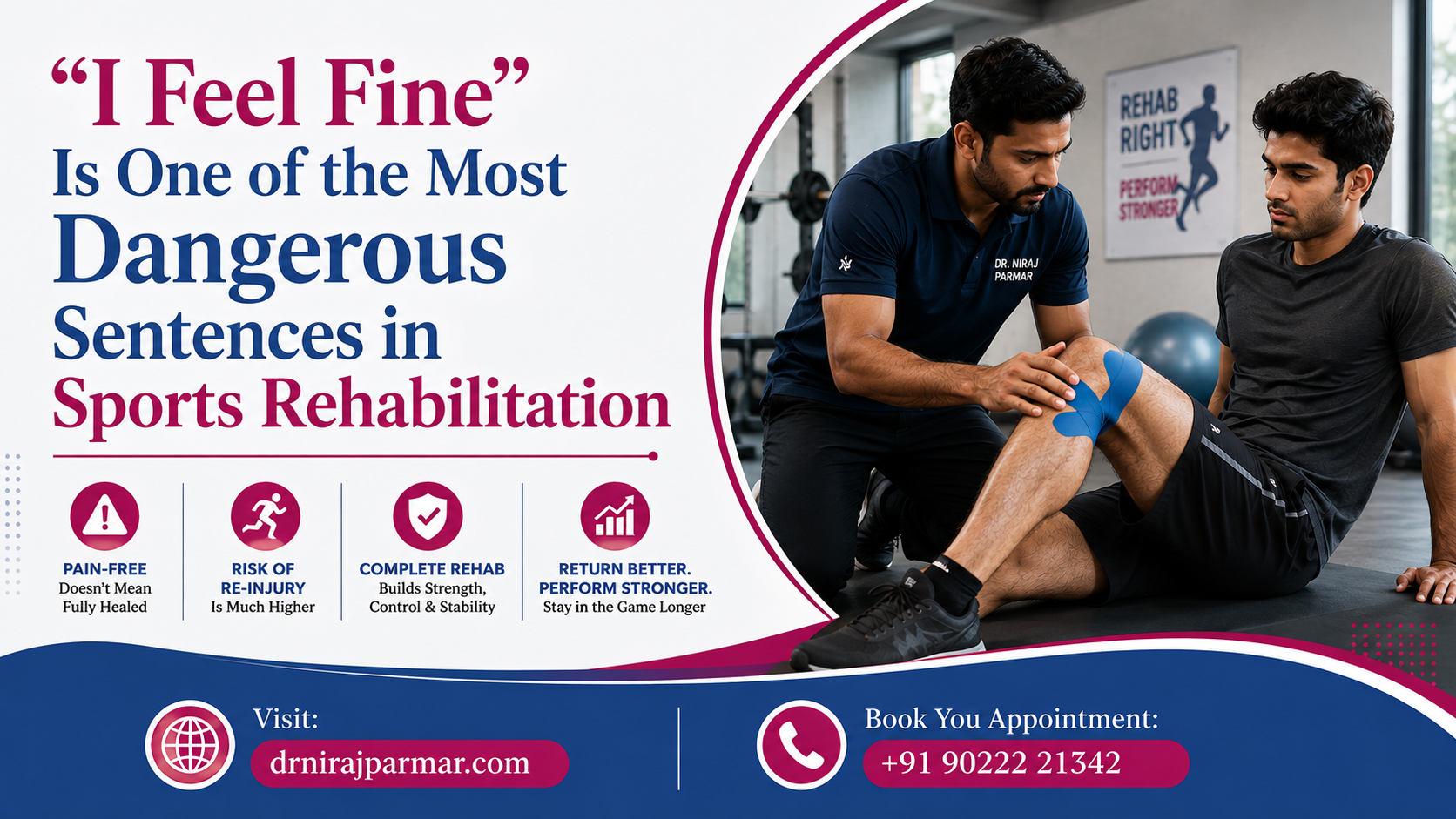
An athlete finishes rehabilitation, starts training again and says, “I feel fine.”
It sounds reassuring. But in sports rehabilitation, feeling fine is only one piece of the puzzle.
An athlete can be pain-free and still lack the strength, control, endurance or confidence required to safely handle the demands of competition.
1. Pain-Free Doesn’t Always Mean Fully Recovered
Pain is an important signal, but it isn’t a complete measure of recovery.
After an injury, pain may settle before the athlete has regained full strength, mobility, balance and neuromuscular control. This is particularly important in injuries involving the knee, ankle, hamstring or shoulder, where sport places high demands on movement and stability.
So when an athlete says, “It doesn’t hurt anymore,” the next question should be:
“Can you perform everything your sport requires?”
2. Sport Demands More Than Rehabilitation Exercises
An athlete may perform squats, lunges or strengthening exercises without discomfort. But competition is unpredictable.
A footballer may need to sprint, suddenly stop, change direction and react to an opponent within seconds. A basketball player may repeatedly jump and land under fatigue. A tennis player may need explosive rotation and rapid lateral movement.
This is why sports physiotherapy must gradually bridge the gap between controlled rehabilitation exercises and real sporting demands.
The body needs to relearn not just how to move, but how to respond under pressure.
3. Strength May Return Before Movement Quality
An athlete can regain impressive numbers in the gym while still having movement deficiencies.
For example, they may have adequate strength but poor single-leg control, altered landing mechanics or difficulty decelerating safely.
These subtle differences may not cause pain during a routine assessment, but they can become important when movement becomes faster, repetitive or unpredictable.
A comprehensive sports injury rehabilitation program therefore looks beyond isolated strength measurements and considers how the athlete moves.
4. The Body Also Needs to Rebuild Load Tolerance
Returning to sport isn’t an on-off switch.
After time away from competition, the body needs to gradually readapt to training load, sprinting, jumping, cutting, contact and repeated high-intensity efforts.
Returning too quickly can create a mismatch between what the athlete wants to do and what the recovering tissues can tolerate.
That is why a progressive return-to-sport program matters. The athlete’s workload should increase according to their recovery, capacity and sporting demands.
5. The Real Question Isn’t “Do You Feel Fine?”
Feeling confident and pain-free is encouraging. But a successful return to sport requires more.
The athlete should be able to demonstrate appropriate strength, movement control, endurance, sport-specific skills and workload tolerance, while also feeling psychologically ready to perform.
Because the goal of rehabilitation isn’t simply to make an athlete feel normal again.
It’s to prepare them to perform when the game gets fast, unpredictable and demanding.
And sometimes, the most important question isn’t:
“Do you feel fine?”
It’s:
“Are you ready for everything your sport is going to ask of you?”