
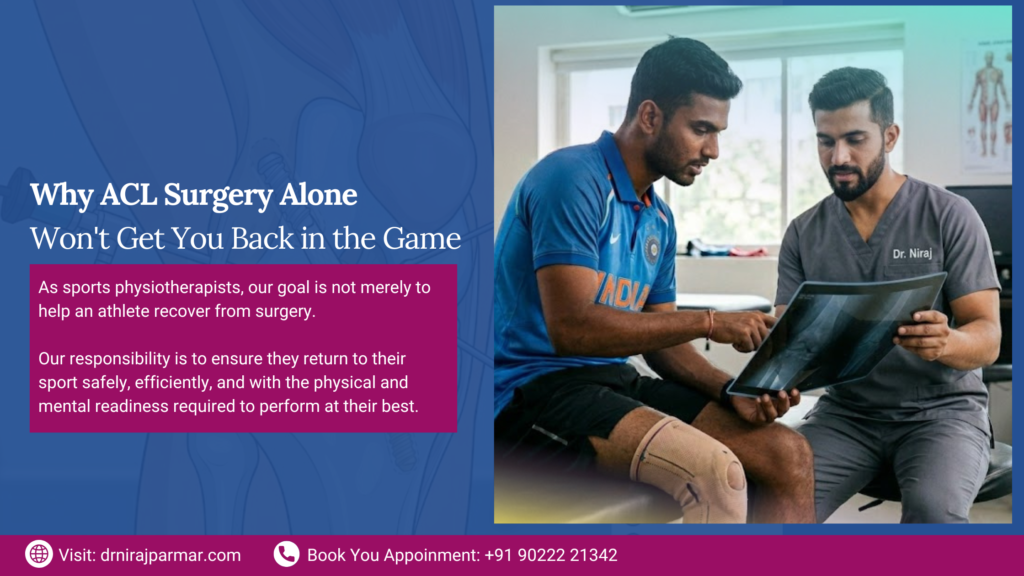
ACL Surgery Repairs the Ligament. Rehabilitation Rebuilds the Athlete.
Most athletes believe that once ACL surgery is completed, the hardest part of recovery is behind them.
While surgery is a critical step, it is only one part of the journey. A successful ACL reconstruction restores the stability of the knee, but it does not automatically restore strength, movement quality, confidence, or athletic performance.
The reality is simple: Your surgeon repairs the ligament. Rehabilitation rebuilds the athlete. And it is rehabilitation that ultimately determines how successfully an athlete returns to sport.
Understanding the Role of ACL Surgery:
ACL reconstruction is designed to replace the damaged ligament and restore mechanical stability to the knee joint.
However, surgery alone cannot address the physical and neurological changes that occur following an ACL injury.
After surgery, athletes often continue to experience:
- Reduced muscle strength
- Loss of balance and coordination
- Altered movement patterns
- Reduced athletic performance
- Fear of re-injury
These factors can persist even when the knee feels stable.
This is why surgery should be viewed as the beginning of recovery—not the end.
Why Feeling Better Doesn’t Mean You’re Ready
One of the most common mistakes athletes make is assuming they are ready to return to sport simply because their pain has improved.
Within a few weeks or months after surgery, swelling reduces, mobility improves, and daily activities become easier. While these are positive signs, they do not necessarily indicate that the knee is prepared for the demands of competitive sport.
Even when symptoms improve:
- The ACL graft is still undergoing biological healing.
- Muscle strength may not have fully recovered.
- Joint control remains impaired.
- Movement mechanics are often altered.
As physiotherapists, we frequently remind athletes that feeling ready and being ready are not always the same thing.
The Hidden Factors Behind ACL Re-Injuries
Research and clinical experience consistently show that many second ACL injuries occur because athletes return to sport before addressing key rehabilitation deficits.
Some of the most common include:
1. Quadriceps Weakness
The quadriceps muscle often loses significant strength after surgery and can take months to recover fully.
2. Strength Asymmetry
One leg may remain considerably weaker than the other, increasing stress on the knee during sport.
3. Poor Movement Mechanics
Compensatory movement patterns can develop during recovery and increase injury risk.
4. Fear of Re-Injury
Even physically recovered athletes may subconsciously alter movement due to fear or lack of confidence.
These hidden deficits can significantly increase the likelihood of re-injury if return-to-sport decisions are rushed.
What Successful ACL Rehabilitation Looks Like
A comprehensive ACL rehabilitation program should focus on much more than pain relief and basic exercises.
Successful rehabilitation includes:
Strength Restoration
Rebuilding strength in the quadriceps, hamstrings, glutes, and core muscles.
Neuromuscular Retraining
Improving communication between the brain and body to restore movement control.
Balance and Agility Training
Preparing the athlete for rapid changes in direction, jumping, and landing.
Sport-Specific Conditioning
Gradually exposing the athlete to the exact demands of their chosen sport.
Psychological Readiness
Helping athletes regain confidence and trust in their knee before competition.
Each of these components plays a critical role in reducing injury risk and improving long-term performance.
How Do We Know an Athlete Is Ready to Return?
Return-to-sport decisions should never be based solely on time since surgery.
Instead, readiness should be evaluated through objective measures such as:
- Strength testing
- Functional performance assessments
- Movement quality analysis
- Balance and agility testing
- Sport-specific performance benchmarks
- Psychological readiness assessments
The calendar does not determine readiness. Performance does.
The Ultimate Goal of ACL Rehabilitation
The goal of ACL rehabilitation is not simply to heal the knee.
The goal is to restore the athlete.
A successful recovery means returning to sport with:
✔ Restored strength
✔ Improved movement quality
✔ Reduced injury risk
✔ Greater confidence
✔ Enhanced performance
When rehabilitation is approached correctly, athletes don’t just return to their sport—they return stronger, safer, and more resilient than before.
Final Takeaway
ACL surgery is an important milestone, but it is only one part of the recovery process.
True recovery happens during rehabilitation.
Because while surgery repairs the ligament, rehabilitation rebuilds the athlete—and that is what ultimately determines a successful return to sport.
– Dr. Niraj Parmar
Sports Physiotherapist & Rehabilitation Specialist