
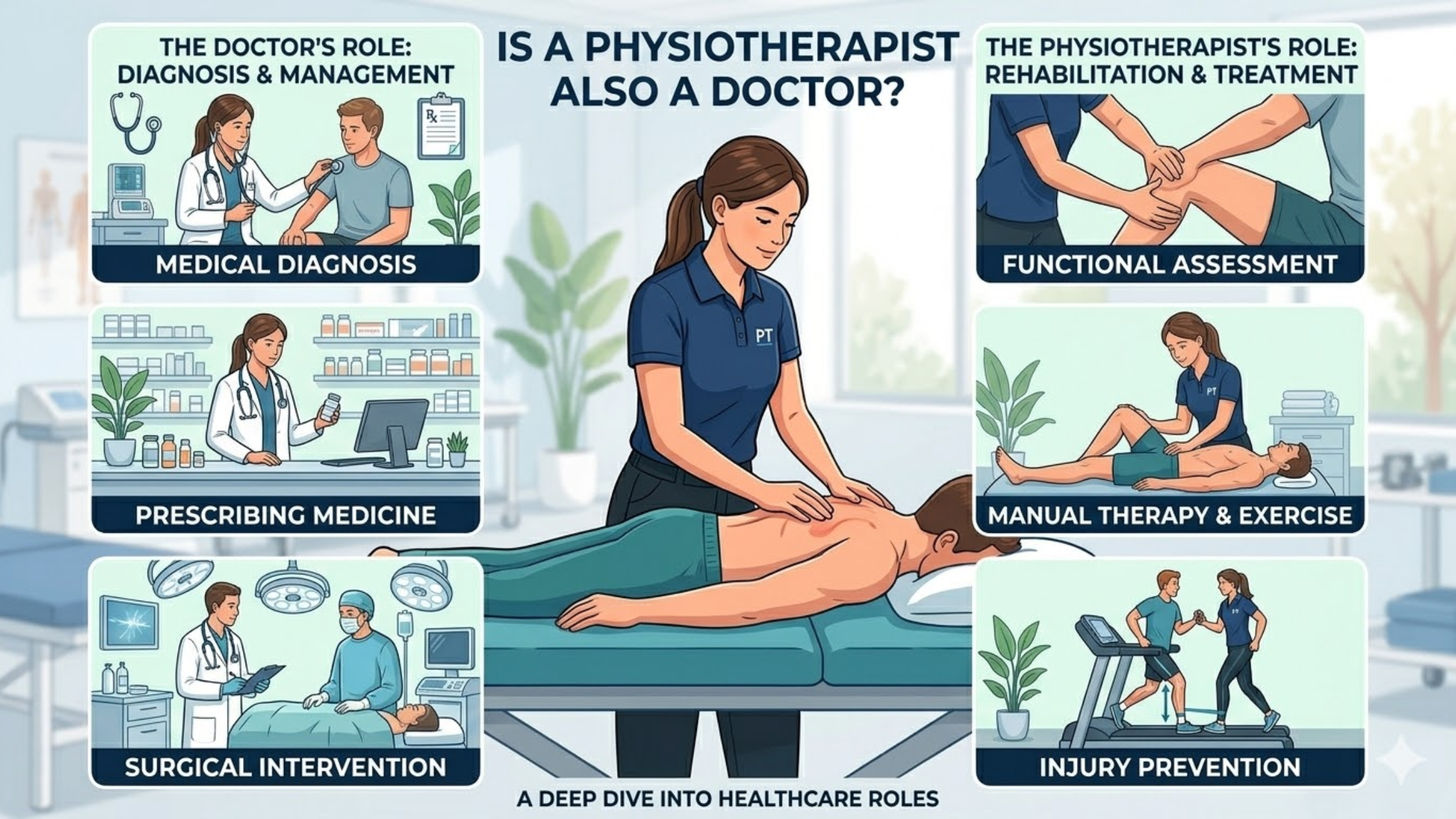
Is a Physiotherapist Also a Doctor? The Honest Answer You’ve Been Looking For
You’ve been told to see a physiotherapist. But a question keeps nagging at you:
“Is a physiotherapist also a doctor? Can I really trust them with my health?”
It’s a fair question — and you deserve a direct, honest answer. Not a vague one, not a defensive one, but the real clinical truth from someone who has spent years in this profession.
The short answer: A physiotherapist is not a medical doctor in the MBBS/MD sense — but they are a highly trained, licensed healthcare professional. In many musculoskeletal and rehabilitation scenarios, seeing the best physiotherapist for your condition is not just appropriate — it’s the most effective first step.
Let’s break this down properly.
What Does “Doctor” Actually Mean?
When most people say “doctor,” they picture someone with an MBBS degree who can prescribe medicines, order blood tests, and perform surgeries. That’s a medical doctor — trained under a traditional allopathic framework through at least 5.5 years of medical school.
But the word “doctor” has a broader academic meaning. A PhD in economics is also called a doctor. A dentist is called a doctor. A veterinarian is called a doctor. The title refers to a level of expertise and qualification — not exclusively to a prescription pad.
This matters because the question “is a physiotherapist also a doctor?” has both a legal answer and a practical answer — and confusing the two is what creates unnecessary doubt in patients’ minds.
The Legal Position in India: Can Physiotherapists Use “Dr.”?
In India, the Indian Association of Physiotherapists (IAP) and several state councils have long debated the use of the “Dr.” prefix. The courts have ruled that physiotherapists are not authorized to use the “Dr.” prefix in a clinical setting unless they hold a PhD — because the title can mislead patients into thinking they are consulting a licensed medical physician.
However, this is a title debate, not a competence debate.
A physiotherapist with a BPT (Bachelor of Physiotherapy) or MPT (Master of Physiotherapy) is legally registered, clinically trained, and professionally competent to assess and treat physical dysfunction — with or without the prefix before their name.
What Qualifications Does a Physiotherapist Actually Hold?
Here is what the educational journey of a qualified physiotherapist looks like in India:
| Qualification | Duration | Focus |
|---|---|---|
| BPT (Bachelor of Physiotherapy) | 4.5 years + 6 months internship | Anatomy, biomechanics, clinical training |
| MPT (Master of Physiotherapy) | 2 additional years | Specialization (ortho, neuro, sports, etc.) |
| PhD (Doctorate in Physiotherapy) | 3+ additional years | Research, advanced clinical expertise |
| Certifications | Ongoing | Dry needling, manual therapy, taping, etc. |
That’s a minimum of 4.5 to 6+ years of clinical education — including hands-on hospital internships treating real patients. Physiotherapy students study human anatomy, neuroanatomy, pharmacology basics, cardiopulmonary physiology, biomechanics, and rehabilitative sciences.
They are not massage therapists. They are not gym trainers. They are clinical healthcare professionals with a defined and regulated scope of practice.
So What Can (and Can’t) a Physiotherapist Do?
Understanding scope of practice is the key to understanding whether a physiotherapist is the right professional for your condition.
A physiotherapist CAN:
- Clinically assess your movement, posture, strength, and neurological function
- Diagnose musculoskeletal and movement-related conditions
- Design and deliver evidence-based rehabilitation programs
- Perform manual therapy — including joint mobilization and soft tissue techniques
- Administer dry needling physiotherapy to release muscle trigger points
- Apply taping physiotherapy (kinesio taping) for injury support and proprioception
- Guide post surgical rehabilitation following orthopaedic or neurological procedures
- Treat sports injuries through sports physiotherapy
- Manage chronic pain, joint conditions, and neurological recovery
- Use modalities like TENS, ultrasound, and laser therapy
A physiotherapist CANNOT:
- Prescribe medications
- Order diagnostic tests like MRI or blood work (without a referral system)
- Perform surgical procedures
- Admit patients to hospital
This distinction isn’t about what’s inferior — it’s about what’s appropriate. Just as you wouldn’t ask a cardiologist to fix a fractured knee, you don’t always need a medical doctor to recover from a sports injury or manage chronic back pain.
The Real-World Difference: Doctors Diagnose, Physiotherapists Rehabilitate
Let’s put this in clinical context.
If you fracture your wrist, you go to an orthopaedic doctor. They x-ray, set the bone, apply a cast, and may prescribe pain relief. Once the bone heals, they refer you to a physiotherapist — because regaining wrist strength, flexibility, and function after fracture is what physiotherapy does best.
If you tear your ACL, a surgeon reconstructs it. Then a sports physiotherapy program takes over for the next 6–9 months to rebuild your knee, restore your gait, and return you to sport safely.
If you’ve had a stroke, the neurologist manages the medical emergency. The physiotherapist manages the neurological rehabilitation — teaching your brain and muscles to reconnect, restoring walking, balance, and arm function.
The two professions don’t compete. They complete each other.
When Should You See a Physiotherapist Directly (Without a Doctor’s Referral)?
Many people wait unnecessarily, assuming they need a doctor’s letter before seeing a physiotherapist. In most private practice settings — including Dr. Niraj Parmar’s clinic — you can book directly for the following:
Go straight to a physiotherapist for:
- Back pain or neck pain that has lasted more than a few days
- Shoulder pain, frozen shoulder, or rotator cuff issues
- Knee pain, runner’s knee, or osteoarthritis symptoms
- Sports injuries — ligament sprains, muscle strains, tendinopathies
- Post-surgical recovery after hip, knee, shoulder, or spine procedures
- Chronic pain that has not responded to rest alone
- Postural problems from desk work or sedentary habits
- Neurological recovery after stroke, Parkinson’s, or spinal injury
See a medical doctor first if:
- You have unexplained weight loss alongside pain
- Pain is constant and unrelenting at night (possible red flag)
- You have recent trauma with suspected fracture
- You have signs of infection (fever, redness, swelling)
- Your pain is associated with bowel or bladder changes
- You have chest pain or cardiovascular symptoms
A good physiotherapist will always refer you appropriately if they assess something outside their scope. That’s a sign of clinical integrity, not limitation.
The 6 Physiotherapy Specialties That Change Lives
Understanding that physiotherapists are specialists within a broad field helps answer the “is a physiotherapist also a doctor” question more meaningfully. Here is what each speciality does:
1. Sports Physiotherapy
Sports physiotherapy focuses on the assessment, treatment, and prevention of sports-related injuries. Whether you’re a professional athlete or a weekend warrior, sports physio programs address acute injuries, performance optimization, and safe return to sport. Dr. Niraj Parmar has worked directly with Pro Kabaddi League teams, bringing elite-level expertise to every patient.
2. Orthopedic Physiotherapy
Orthopedic physiotherapy manages conditions affecting bones, joints, muscles, and ligaments — including arthritis, frozen shoulder, herniated discs, and fracture recovery. It’s one of the most commonly needed physiotherapy specialities.
3. Manual Therapy
Manual therapy is a hands-on clinical approach involving joint mobilization, manipulation, and soft tissue work. It’s highly effective for stiff joints, cervical pain, thoracic spine dysfunction, and mobility restrictions. Unlike a general massage, manual therapy is a targeted clinical intervention based on biomechanical assessment.
4. Taping Physiotherapy
Taping physiotherapy — including kinesio taping — supports injured or overloaded structures, improves proprioception, reduces swelling, and facilitates correct muscle activation. It is widely used in sports rehabilitation and post-injury recovery.
5. Dry Needling Physiotherapy
Dry needling physiotherapy uses fine needles to target myofascial trigger points — tight, painful knots in muscle tissue. Unlike acupuncture, dry needling is rooted in Western anatomy and neuroscience. It is highly effective for chronic muscle pain, tension headaches, and persistent trigger point pain.
6. Post Surgical Rehabilitation
Post surgical rehabilitation is a structured, progressive program designed to restore function following orthopaedic or neurological surgery. Without proper rehab, even the best surgical outcome can fall short. Structured post-surgical physio accelerates tissue healing, prevents complications, and rebuilds functional strength.
Busting the 4 Most Common Myths About Physiotherapists
Myth 1: “They’re just masseurs”
Physiotherapists may use hands-on techniques, but their interventions are clinically prescribed, anatomically targeted, and outcome-driven. A massage therapist works on relaxation. A physiotherapist works on function.
Myth 2: “You need a doctor’s referral first”
In most private physiotherapy clinics in India, direct access is fully permitted. You can book your assessment without a prior referral.
Myth 3: “Physiotherapy is only for sports injuries”
Physiotherapy is used for stroke recovery, post-surgical rehab, chronic pain management, respiratory conditions, women’s health, paediatric disorders, and neurological rehabilitation — far beyond sports.
Myth 4: “If physiotherapy hasn’t worked before, it never will”
Physiotherapy outcomes depend heavily on accurate diagnosis, technique quality, and individual program design. A poorly designed generic program produces poor results. Expert, individualized physiotherapy is a completely different experience.
Is a Physiotherapist Also a Doctor? — The Final, Clear Answer
A physiotherapist is not a medical doctor in the MBBS/MD sense. They cannot prescribe medicines or perform surgery.
But they are a licensed, post-graduate trained healthcare professional with deep clinical expertise in the assessment and treatment of physical dysfunction, pain, and rehabilitation. In many conditions — including most musculoskeletal, sports, and post-surgical cases — they are the most appropriate clinician to see.
The question to ask is not “are they a doctor?” The question is: “Are they the right professional for what my body needs right now?”
For pain, movement problems, sports injuries, and recovery — the answer is almost always yes, a physiotherapist is exactly who you need.
Book an Appointment with Dr. Niraj Parmar
If you’re in pain, recovering from surgery, dealing with a sports injury, or simply not moving the way you used to — don’t wait.
Dr. Niraj Parmar is a Senior Sports Consultant at Dr. L.H. Hiranandani Hospital, Powai, Mumbai. With 7+ years of clinical experience, a 99% recovery rate, and hands-on expertise in sports physiotherapy, orthopedic physiotherapy, manual therapy, dry needling, taping physiotherapy, and post surgical rehabilitation — he delivers the kind of care that gets real results.
📍 Location: Dr. L.H. Hiranandani Hospital, Powai, Mumbai – 400076 📞 Call / WhatsApp: +91 902 222 1342 📧 Email: nirajp8097@gmail.com 🕐 Hours: Monday – Friday, 10 AM – 8 PM
Recovery doesn’t have to wait. The right expert, the right care, the right outcome — it starts with one appointment.
Frequently Asked Questions (FAQ)
Q1: Is a physiotherapist also a doctor in India?
A physiotherapist is not a medical doctor (MBBS/MD) in India. They are licensed healthcare professionals who hold a BPT or MPT degree and are trained in physical rehabilitation, movement science, and musculoskeletal care.
Q2: Can I see a physiotherapist without a doctor’s referral?
Yes. In most private physiotherapy clinics in India, you can book directly. You do not need a referral for conditions like back pain, sports injuries, shoulder stiffness, knee pain, or post-surgical recovery.
Q3: Why do some physiotherapists use “Dr.” before their name?
Physiotherapists who hold a PhD may use the “Dr.” prefix academically. However, courts in India have ruled that using “Dr.” in a clinical setting is not appropriate for physiotherapists who do not hold a medical degree, to avoid confusion with medical doctors.
Q4: What is the difference between a physiotherapist and an orthopaedic doctor?
An orthopaedic doctor is a surgeon who diagnoses bone and joint conditions, prescribes medications, and performs surgeries. A physiotherapist focuses on non-surgical rehabilitation, movement restoration, and pain management — often working alongside the orthopaedic specialist.
Q5: Can a physiotherapist treat me after surgery?
Yes — post surgical rehabilitation is one of the core specialities of physiotherapy. A structured rehab program after orthopaedic or neurological surgery is essential for full recovery.
Q6: What conditions does Dr. Niraj Parmar treat?
Dr. Niraj Parmar treats a wide range of conditions through sports physiotherapy, orthopedic physiotherapy, manual therapy, dry needling physiotherapy, taping physiotherapy, and post surgical rehabilitation. Contact the clinic for a specific assessment.
Q7: Is dry needling the same as acupuncture?
No. Dry needling physiotherapy is based on Western anatomy and neuromuscular science, targeting myofascial trigger points for pain relief. Acupuncture is based on traditional Chinese medicine meridian theory. The needles may look similar, but the approach and goals are different.
Q8: How many sessions of physiotherapy will I need?
This varies by condition, severity, and individual response. Dr. Niraj Parmar provides a clear treatment plan after the initial assessment, including realistic session estimates and measurable goals.