
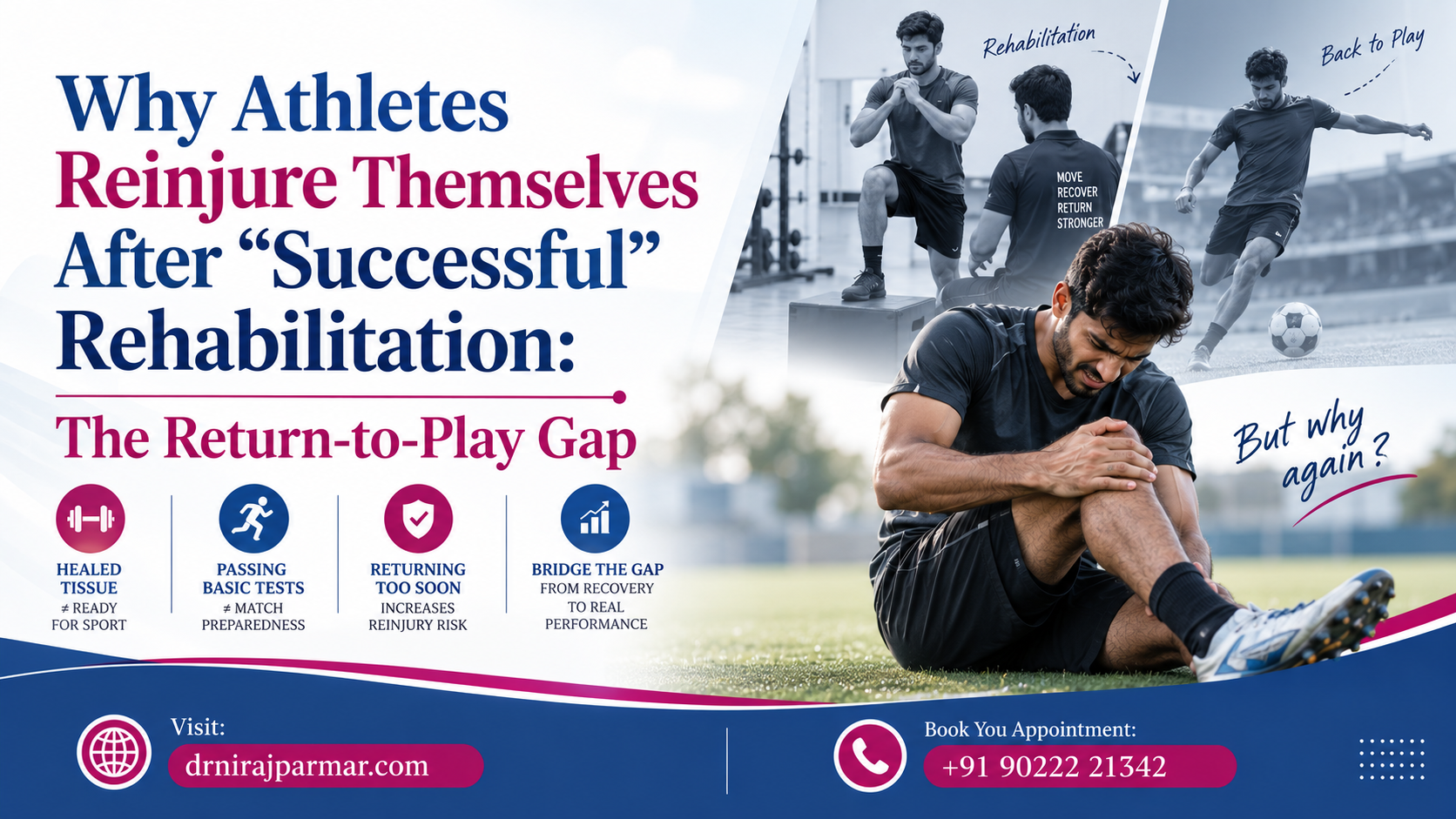
An athlete completes rehabilitation, feels strong, has little or no pain, and is cleared to start training again. A few weeks later, the same injury—or a related one—returns.
It can feel as though the rehabilitation failed. But sometimes the real problem is different: the athlete recovered enough to exercise, but not enough to tolerate the demands of competition.
Pain-Free Does Not Always Mean Ready to Play
Pain is important, but it is only one part of recovery.
An athlete may be able to walk, jog, lift weights or complete basic drills without discomfort while still having deficits in strength, balance, coordination, movement control or endurance.
This is one of the most important principles in sports injury rehabilitation: symptom recovery and performance recovery are not necessarily the same thing.
The question should therefore move beyond, “Does it still hurt?”
A better question is: “Can your body repeatedly handle what your sport is about to demand from it?”
The Jump From Rehabilitation to Sport Can Be Bigger Than It Looks
A controlled rehabilitation session is very different from a competitive environment.
Consider a footballer. Running in a straight line may be comfortable, but a match also involves sudden acceleration, deceleration, cutting, jumping, landing, physical contact and decision-making while fatigued.
The same principle applies across sports.
A successful return to play requires the injured area to tolerate not only movement, but also speed, repetition, fatigue and unpredictable situations.
Returning before these qualities have been rebuilt can leave an athlete physically underprepared even when they feel recovered.
Strength Is Important, but It Is Not the Whole Test
Sports physiotherapists often assess more than whether an injured muscle or joint has “healed.”
Depending on the injury and sport, return to sport rehabilitation may include assessment of strength, single-leg control, balance, hopping, agility, change of direction, sport-specific movement and tolerance to increasing training loads.
Movement quality also matters.
An athlete may complete a task but compensate by shifting more work to another part of the body. These compensations may only become obvious once speed or fatigue increases.
That is why objective testing can add valuable information beyond how an athlete feels.
The Missing Stage: Returning to Performance
Recovery is better viewed as a progression rather than one clearance date.
An athlete may first return to general activity, then modified training, full training, competition and eventually their previous level of performance.
This final stage is often overlooked.
Being allowed to participate does not automatically mean the athlete is ready for full match intensity, normal playing minutes or their previous training volume.
Gradually rebuilding exposure gives the body time to adapt again to the forces and workload of sport.
A Successful Rehabilitation Should Prepare You for What Comes Next
The goal of rehabilitation should not simply be to make an injury stop hurting. It should prepare the athlete for the environment they are returning to.
Before returning fully to sport, readiness should be considered through several lenses: symptoms, strength, movement quality, sport-specific performance, training tolerance and psychological confidence.
If you are recovering from a sports injury, avoid judging readiness only by time passed or pain relief. A sports physiotherapist can help assess whether your body has genuinely regained the capacity required for a safer return to play and return to performance.